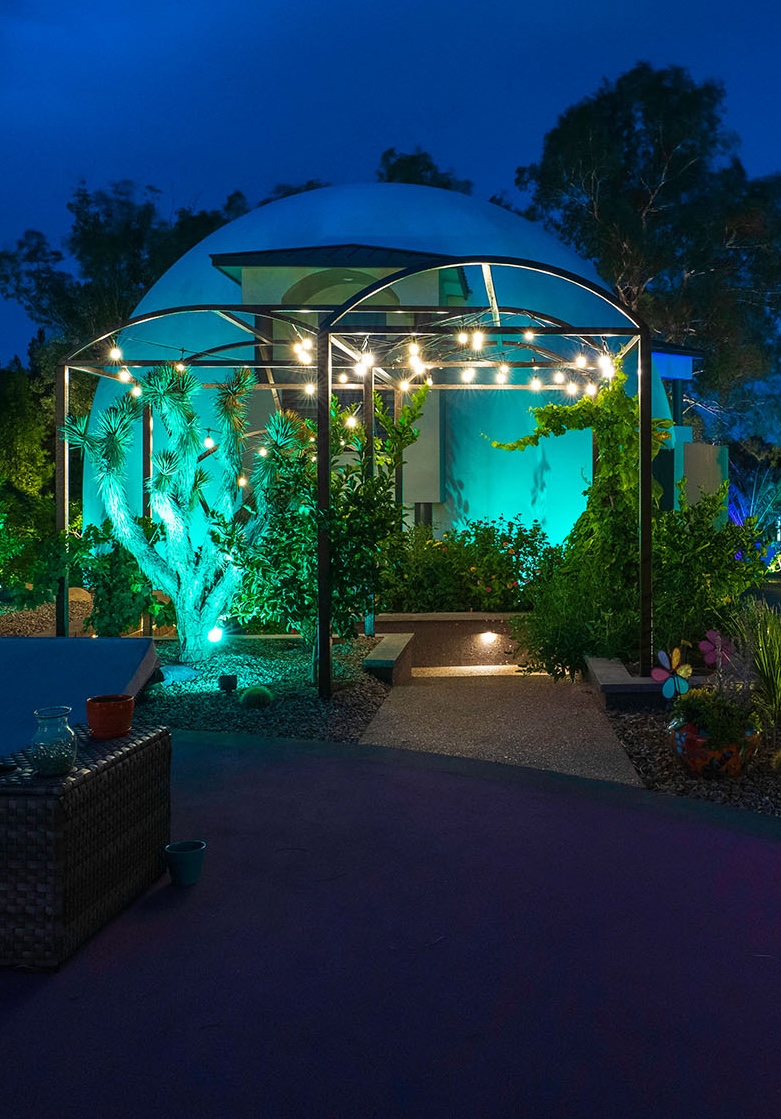
Landscape Lighting in Las Vegas
The complete guide to outdoor lighting design, fixtures, and installation for homes across the Las Vegas Valley.
Landscape lighting is a low-voltage outdoor lighting system that illuminates trees, walkways, patios, pools, and architecture so a property looks beautiful and stays safe after dark. In Las Vegas, where outdoor living happens mostly after sunset for much of the year, a well-planned landscape lighting design is one of the highest-impact upgrades a homeowner can make, improving curb appeal, security, and how often the backyard actually gets used.
This guide explains the main types of landscape lighting, the techniques professional designers use, how to plan a lighting layout for a Las Vegas yard, which fixtures survive the Mojave Desert climate, and the mistakes that leave so many homes with glare, dark spots, and failed lights within a few seasons. If you are researching outdoor lighting for your Las Vegas or Henderson home, start here.
Why Landscape Lighting Matters More in Las Vegas
Most cities treat outdoor lighting as a finishing touch. In the Las Vegas Valley it is closer to a necessity. Summer highs routinely pass 100°F, so pools, patios, and outdoor kitchens see their heaviest use in the evening. Without lighting, those spaces become unusable exactly when the weather finally cooperates.
Las Vegas landscapes also lend themselves unusually well to lighting. Mature palms, mesquites, and palo verdes throw dramatic shadows when uplit. Stucco walls, stone veneer, and stacked-block retaining walls have texture that comes alive under grazing light. Desert rock mulch reflects soft path lighting without the washed-out look of a lawn. And because most homes sit on relatively small lots with high privacy walls, a modest number of fixtures can transform the entire outdoor space.
Finally, there is security. Side yards, gates, and garage entries on Las Vegas homes are often deep in shadow. Strategic outdoor lighting removes hiding spots, gives cameras a clear picture, and makes steps and pool edges visible to guests and children.
Types of Landscape Lighting Explained
A professional landscape lighting system is never built from one kind of fixture. Designers layer several types, each with a specific job, so the yard reads as a single composed scene rather than a row of identical lights. Here are the fixture types used in most Las Vegas outdoor lighting designs.
| Fixture type | Best used for | Typical placement | Effect |
|---|---|---|---|
| Path lights | Walkways, driveways, garden beds | Every 6–8 ft along a path, staggered | Soft pools of light for safe navigation |
| Spotlights | Trees, statues, columns, façades | At the base of the feature, aimed upward | Dramatic uplighting and focal points |
| In-ground well lights | Palms, entry columns, walls | Flush with grade at the base of the feature | Hidden source, clean high-end look |
| Wall washers | Stucco walls, stone veneer, garage fronts | 2–4 ft from the wall, aimed across it | Even, broad illumination that shows texture |
| Hardscape lights | Retaining walls, seat walls, steps, outdoor kitchens | Under the wall cap or stair nosing | Thin line of light on masonry |
| LED strip lighting | Pergola beams, counters, stair treads, edges | Recessed in channels along the edge | Continuous linear glow |
| Silhouette bollards | Pool decks, courtyards, modern walkways | Along borders, 8–10 ft apart | Sculptural markers with patterned light |
| Bistro lights | Patios, pergolas, dining areas | Overhead in zig-zag or parallel runs | Warm, resort-style ambience |
| Downlights | Patios, lawns, seating areas | High in trees or under eaves, aimed down | Natural moonlight effect |
| Color-changing RGBW | Pools, water features, entertaining zones | Anywhere a standard fixture goes | Adjustable hues for holidays and events |
Path and Area Lights
Path lights are the workhorse of outdoor lighting. They spread a soft, wide circle of light at ground level so people can see where they are stepping. The classic mistake is lining them up like a runway; a staggered layout with fixtures every six to eight feet looks natural and covers the walkway just as well.
Spotlights and Uplights
Spotlights throw a narrow, directional beam. Placed at the base of a palm, a multi-trunk mesquite, or a stone column, they create the dramatic uplighting that defines high-end Las Vegas landscape lighting. Beam spread matters: a narrow 15-degree beam suits a tall, slender palm, while a 60-degree flood covers a broad canopy tree.
In-Ground Well Lights
Well lights sit flush with the ground so only the light, never the fixture, is visible. They are ideal for entry columns, house façades, and trees in rock mulch where a stake-mounted spotlight would look cluttered.
Wall Washers and Hardscape Lights
Wall washers spread a broad, even blanket of light across large surfaces, eliminating dark perimeters and showing off stone and stucco. Hardscape lights are compact fixtures built into retaining walls, seat walls, and step risers, usually tucked under the cap so the source is hidden and the masonry glows.
Strip Lighting, Bollards, and Bistro Lights
LED strip lighting gives designers a continuous line of light along pergola beams, outdoor kitchen counters, and stair treads. Silhouette bollards double as sculpture and wayfinding along pool decks and courtyards. Bistro lights overhead turn a patio into an outdoor room with the warm, layered glow of a resort terrace.
Color-Changing Landscape Lighting
RGBW fixtures produce warm white for everyday use and a full spectrum of colors on demand. Homeowners use them for holidays, game days, and pool parties, all controlled from a phone, with no bulbs to swap.
Landscape Lighting Techniques Professionals Use
Fixtures are the tools; techniques are how designers use them. The same spotlight can create five completely different looks depending on where it sits and where it points.
| Technique | How it works | Best subjects in Las Vegas yards |
|---|---|---|
| Uplighting | Fixture at the base aimed upward | Palms, mesquites, columns, front façades |
| Downlighting | Fixture mounted high, aimed down | Patios, lawns, seating areas, driveways |
| Moonlighting | Downlight placed in a tree canopy | Backyard trees over patios and pools |
| Grazing | Fixture close to a surface, aimed along it | Stucco, stacked stone, block walls |
| Wall washing | Fixture farther back, aimed across a surface | Smooth walls, garage fronts, privacy walls |
| Silhouetting | Light behind the subject, toward a wall | Agaves, yuccas, sculptural cacti |
| Shadowing | Light in front of the subject, toward a wall | Ocotillos, open-canopy trees |
| Cross lighting | Two fixtures from opposite angles | Specimen trees, statues, fountains |
Uplighting is the signature of Las Vegas outdoor lighting. A single fixture at the base of a mature palm sends light up the trunk and into the fronds, turning the tree into a focal point visible from the street.
Downlighting and moonlighting create the softest, most natural effect. Mounted high in a tree or under a roof eave and aimed down through branches, they cast dappled light across a patio much like a full moon. This is the technique to use over dining areas, where uplights would shine into guests’ eyes.
Grazing and wall washing are about surfaces. Grazing places the fixture within a foot or two of a textured wall and aims it up along the surface, exaggerating every ridge of the stone. Wall washing pulls the fixture back several feet for a smooth, even glow.
Silhouetting and shadowing use walls as canvases. Desert plants with strong architectural shapes, such as agaves, yuccas, and ocotillos, look striking either backlit as a dark outline or front-lit so their shadow spreads across the wall behind them.
What a Professional Landscape Lighting Design Includes
The difference between a yard that looks lit and a yard that looks designed comes down to planning that happens before a single fixture goes in the ground. A professional landscape lighting company approaches a Las Vegas property the way an interior designer approaches a room: with focal points, layers, and a clear idea of where the light will be seen from.
Designers evaluate the property at the time of day the lighting will actually be used, identifying the features worth highlighting, the areas that need safety lighting, and the spaces the family uses after dark.
Only a handful of elements should carry the scene: a mature palm, the front façade, a feature wall, the main gathering area. Everything else receives softer, supporting light so the composition has depth instead of uniform brightness.
Ambient light for general visibility, task light for steps and paths, and accent light for drama. Each layer uses different fixtures and different brightness levels, and the balance between them is what makes a design feel intentional.
Fixtures are positioned relative to the main viewing angles — typically the street, the entry, the patio, and the view from inside the house — so the glow is visible but the fixture itself never shines in anyone’s eyes.
Transformer sizing, wire gauge, run lengths, and voltage drop are calculated so the last fixture on the line is as bright as the first, and the system has headroom for future additions.
Front yard, backyard, pool, and entertaining areas are wired as separate zones with their own schedules, dimming levels, and, on smart systems, app control and color scenes.
After installation, every fixture is fine-tuned after dark to remove glare and hot spots. This final adjustment is the step most often skipped, and the one that most separates a professional result from an amateur one.
Most Las Vegas homes need less than you’d think. A complete design typically uses eight to fifteen well-placed fixtures to transform a standard lot, while estates and commercial properties scale up from there.
Fixtures That Survive the Las Vegas Desert
The Mojave Desert is one of the hardest environments in the country for outdoor lighting. Intense UV, blowing dust, monsoon downpours, and 60-degree daily temperature swings destroy consumer-grade fixtures in a few seasons. Professional landscape lighting companies in Las Vegas specify equipment for these conditions from the start.
| Component | Consumer-grade (big-box) | Professional-grade |
|---|---|---|
| Fixture body | Plastic or thin aluminum; cracks, fades, corrodes | Solid brass, copper, or marine-grade aluminum; develops a patina, never fails |
| Light source | Halogen or non-replaceable LED; 2,000–4,000 hours | Sealed LED module; 40,000–50,000 hours |
| Voltage | 120V line voltage or weak solar | 12–15V low voltage through a rated transformer |
| Wiring | Thin cable, plug connectors that corrode | Direct-burial cable, waterproof gel-filled connections |
| Controls | Manual switch or basic timer | Astronomical timer, photocell, app control, dimming, color scenes |
| Warranty | 1 year or none | Lifetime on brass fixtures, 10–15 years on LEDs |
Low-voltage LED is the standard
Running at 12 to 15 volts through a transformer, low-voltage landscape lighting is safe around pools, pets, and children, uses up to 80% less electricity than halogen, and typically costs only a few dollars a month to operate even with a dozen or more fixtures.
Brass and copper outlast everything else
These metals do not rust, do not become brittle in UV, and only grow more attractive as they age. They cost more up front and are the reason professional systems still look new after a decade.
Smart controls change how the system is used
Sunset-to-sunrise scheduling means the lights are simply always right. App-based dimming and zoning let homeowners set a soft mood for a quiet evening or bring everything up for a party, and RGBW fixtures add holiday colors without ladders or extension cords.
Why DIY Landscape Lighting Usually Fails in Las Vegas
Big-box lighting kits promise a quick weekend upgrade. In practice, most homeowners who try them end up calling a landscape lighting company within a year or two. The reasons are consistent.
Identical path lights in a straight line every three feet turn a walkway into an airport taxiway. Professional layouts stagger fewer, better fixtures for a natural look.
Fixtures aimed at the house or toward seating areas shine directly into people’s eyes. Designers position and shield every light so the effect is visible and the source is not.
Undersized wire and overloaded transformers cause voltage drop, leaving the far fixtures noticeably dimmer than the near ones.
Plastic housings crack in the heat, cheap connectors corrode, and non-replaceable LEDs fail, turning the whole kit into landfill.
Trenching for wire without knowing where drip lines and valves run is the most common way a DIY lighting project turns into an irrigation repair. Landscape companies that install both know exactly what is under the rock.
Solar path lights look bright in the box and fade to a faint glow within hours of sunset, with batteries that give out after a season of Las Vegas heat.
A professionally designed and installed system avoids every one of these problems, comes with real warranties, and is engineered to be expanded rather than replaced.
Frequently Asked Questions
How much does landscape lighting cost in Las Vegas?
Landscape lighting cost depends on the number of fixtures, fixture quality, property size, and the level of control. A front-yard accent package with a few spotlights and path lights sits at the entry level, while a full-property design with hardscape lighting, color-changing zones, and app control is a larger investment. Most professional installations are priced per fixture, installed, with the transformer and controls included, and a written quote follows a free on-site consultation.
Does landscape lighting increase home value?
Yes. Outdoor lighting is one of the most visible exterior upgrades and consistently improves curb appeal, perceived security, and the usable square footage of a home. Real estate listings with professionally lit exteriors photograph better and stand out in evening showings.
How long do LED landscape lights last?
Professional-grade LED landscape lights are rated for 40,000 to 50,000 hours. At six hours per night, that is roughly 18 to 20 years of use with no bulbs to replace.
Is low-voltage landscape lighting safe around pools and pets?
Yes. Low-voltage systems run at 12 to 15 volts through a transformer, which makes them safe around water, children, and animals, and far more energy-efficient than 120-volt line-voltage lighting.
Can landscape lighting be added to an existing yard?
Yes. Most landscape lighting installations in Las Vegas are retrofits on established properties. Low-voltage cable is routed through rock mulch and planting beds with minimal disturbance to turf, pavers, and irrigation.
How much does it cost to run landscape lighting every night?
A typical low-voltage LED system with 10 to 15 fixtures uses roughly the same electricity as a single incandescent bulb, which works out to only a few dollars per month on a Las Vegas power bill.
Can old halogen landscape lighting be converted to LED?
Yes. Existing halogen systems can usually be upgraded with LED lamps or new LED fixtures on the same wiring, cutting energy use by up to 80% and eliminating regular bulb replacement.
Do landscape lights attract bugs?
Warm-white LEDs in the 2700K to 3000K range attract far fewer insects than older halogen or cool-white lights, which is why professional designs use warm color temperatures throughout.
Professional Landscape Lighting Design & Installation in Las Vegas
V.I.P. Landscaping designs and installs custom landscape lighting in Las Vegas, Henderson, Summerlin, and across the Las Vegas Valley — from bistro lights and path lighting to spotlights, hardscape lights, and color-changing smart systems. As a licensed, bonded, and insured Nevada contractor with more than 18 years of experience, the team handles every step from design and fixture selection to installation, aiming, and ongoing maintenance.
Call 702.423.1944Free landscape lighting consultation · NV license C-10 #69752 & C-18 #80912


